 18 Dec 2012
 Posted by mattwright
The perfect mix of workout frequency, duration, and intensity will lead to an overall training stress that causes your body to respond positively to training and allow you to paddle faster and/or farther than you could previously. If, however, you attempt to handle too great of a training stress you will overload your body’s capacity to adapt. This will lead to overtraining syndrome. Conversely, if you fail to stimulate your body you will undertrain and fail to achieve your potential as a paddle athlete. Training by heart rate is one way to help make sure that you are neither doing too much or too little in a given stand up paddle training session.Performing an anaerobic threshold test will help you get your heart rate based SUP race training dialed in.
To train by heart rate, you will first need to determine your “training zones.” There are many ways to determine your heart rate based training zones. For example, some coaches us maximum heart rate to determine training zones. Others estimate anaerobic threshold (AT) to develop your heart rate zones. Every method has its pros and cons but they all work and there is no absolute right or wrong way to approach this topic. In our experience, we have found that using anaerobic threshold o develop your HR training zones is superior to other methods because:
- For many athletes it is easier to test for their AT. Many athletes find it difficult to get to their maximum heart rate during testing.
- Unlike your maximum heart rate, your AT will change over time. Anaerobic threshold is highly trainable and variable throughout the training year while your HR is more or less static as it is genetically predetermined. This factor will allow you to dial in your training over the course of the year.
Because your anaerobic threshold is trainable (that’s point in all of this, right?) and is used to determine target training heart rates, it is suggested that you perform AT tests periodically throughout the training year. In a very fit person, anaerobic threshold can be as high as 90-92% of max HR. As the season progresses, even a rise of 2-4 beats in ATHR is a significant improvement.
We suggest performing an AT test 2-3 times during your training year. Other coaches recommend even more testing than that but our feeling is that too much testing encourages athletes to worry about their next test rather than their training. Additionally, AT testing requires putting out a significantly hard effort and performing these hard efforts only have a place at certain times in the training year.
If you are coming to paddling from a different sport, you will find that AT is sport specific. Stated another way, you will have different heart rate parameters for different sports. For example, your swimming AT is likely going to be lower than cycling, and your cycling AT, will be lower than that of running. Paddling generally falls somewhere between swimming and cycling.
The reason that AT will be different for different sports has to do with the numbers and sizes of muscles recruited for the sport and whether the sport it is a weight bearing activity. For example, while running you are supporting your full body weight and using the larger muscle groups of the legs. Cycling uses these large muscle groups, but is a weight supported activity and thus the lower HR (unless you are standing up ‘out of the saddle’). Swimming uses smaller muscle groups as the prime movers (the arms) while water supports the body. SUP uses your legs more than swimming as you need to support your body weight but your legs do not do any significant movement.
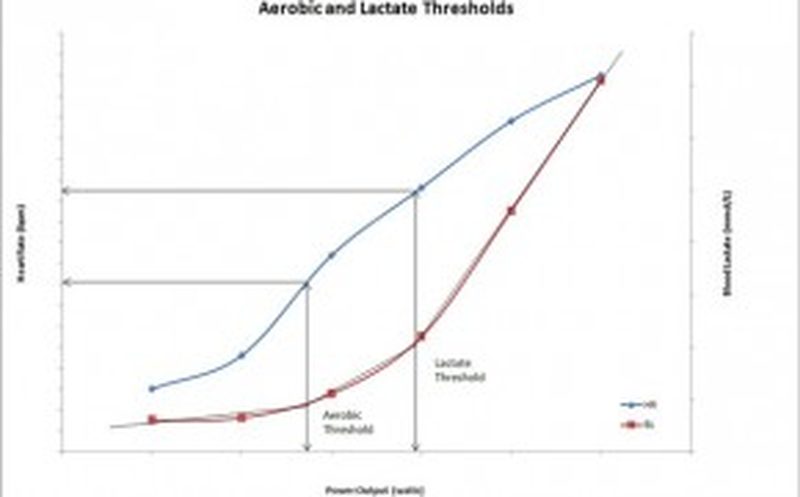
There are many ways to measure your lactate threshold. The gold standard is to obtain blood samples in a laboratory setting. For most us, this is not a practical solution. Fortunately, you can estimate your lactate threshold by doing a simple AT field test.
To perform an SUP anaerobic threshold field test:
- Pick a day with flat water and a steady or calm wind
- Use a medium size paddle blade
- Warm up for 10-15 minutes with an easy paddle
- Perform a 30 minute hard to very hard effort
- Be sure to do what you can to keep things steady and do your best to pace the interval. Your goal is to keep a relatively constant effort throughout the test. You do not want to go all out…redline..and finish the interval at half effort
To estimate your AT that your average heart rate for the middle 20 minutes of the 30 minute effort. In our experience, that average heart rate will be your AT HR or your AT HR will be 1-3% higher.
A full discussion of how to use your AT to determine training intensity during your stand up paddle training sessions is found in the Riding Bumps Training Program