
 23 Feb 2013
 Posted by mattwright
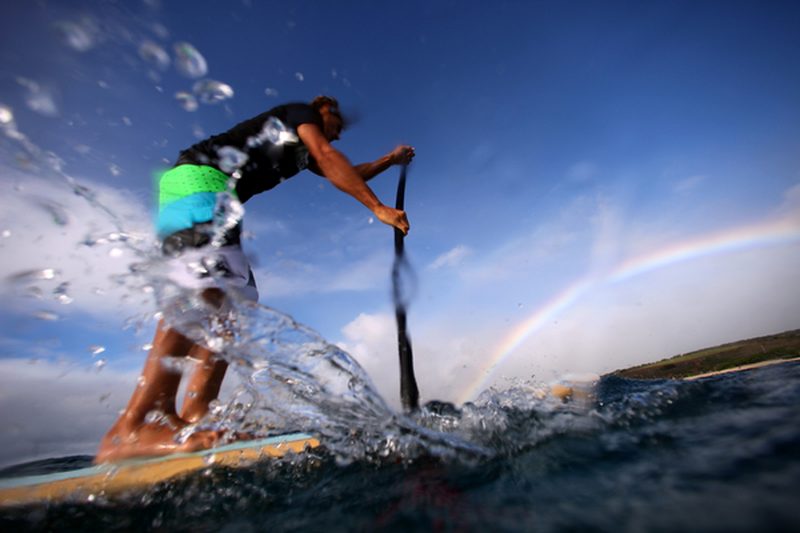
Although high intensity interval training and paddle racing seem to be all about fitness, for those of us who perform intervals or paddle race, we know that the real test is what is going on in an athlete’s head.
Once you start paddling at 90 + percent of your maximum heart rate (80 + percent for beginners or less experienced paddlers) pain sets in and things can go sideways in a hurry. Mental demons creep out of the far reaches of your mind and the questions and negative self talk begin.. “Can I do this?”… “Am I blowing up?”… “Did I go out too hard?”.. “Did I train enough?”… “Is my nutrition where it needs to be?”
Without a good strategy to quell the self talk, your demons will strike grand bargains with you and convince you that if you let up for just a few seconds you can close the gap after you rest or make it up in the next interval. Don’t bargain with your demons. Demons do not like pain. Training your demons to like pain can be a challenge. SUP racing and paddle race training is a head game.
Your head is the last 10%
As a coach, one of my challenges is to help athletes learn to deal with pain. It is very easy to get a committed paddler to improve their fitness. At some point, however, most athletes will plateau and my challenge as a coach is to help athletes find that “edge” that they need to continue improving. That “edge” is often found in their mind.
The last hurdle, and maybe the last 10 percent of an athlete’s potential, is getting them to stop striking deals with their demons. That last 10 percent is a journey of self discovery.
Pain coping mechanisms
There are two general coping mechanisms that athletes use to overcome pain while training and paddle racing. They are are not created equal.
Coping mechanism #1: Dissociation: Many athletes attempt to hide from the pain. They try to go to a “happy place” and think “happy thoughts.” They might tell themselves that “the end is near…just 5 more minutes” as they try to distract themselves from the pain. They might focus on the water or the pretty colors on their SUP or prone paddle board, them or the dolphins, or the horizon or anything else other than the pain.
Like a little kid on the playground who closes their eyes and just stands there when a bully is about to punch them in the face, these athletes are attempting to do the mental equivalent by pretending that the pain is not really there. In our experience, athletes who try to cope with pain using this strategy do not fare that well. Moreover, we know of no elite athletes who use this coping mechanism. Some research shows that dissociation can be effective at low to moderate intensity levels but may be less effective when the demons really go to work in your head. We do not recommend dissociation as a coping mechanism.
Coping mechanism #2: Association: Association is a coping mechanism where athletes concentrate on what they are doing and “go into the pain.” Some focus directly on the pain. Some focus on the body part that is hurting and watch that body part in their mind. They feel every movement and nuance in that body part. Some visualize the muscle fibers in their arms and backs doing the work contracting and relaxing. Some count their paddle strokes as they focus on their movement. Some picture themselves as an engine and their arms are pistons.
In our experience, elite athletes always employ some twist on an association type of coping mechanism. It is the coping mechanism that we recommend to our athletes.
Dealing with pain takes practice.
Learning to deal with pain is part of SUP race training. You will get better at it over time but it is something that you need to train. If you train your cognitive mechanisms to deal with pain (e.g. practice association) your pain tolerance will improve.
If you are an athlete who has been using a dissociation type of coping mechanism and want to try something new, we suggest starting by counting your paddle strokes. Counting your paddle strokes will force you to focus on what you are doing and concentrate on your body. In theory, counting is simple. All you need to do is count your paddle strokes as you paddle. 1,2,3,4….1,2,3,4. While you are counting, focus on your paddle stroke. Focus on your arms, your back, your hands on the paddle, your hand or paddle placement in the water, your legs stabilizing you as you paddle, etc.
In practice, it can be very difficult to stay focused on your counting when the pain gets bad and the demons start striking deals with you. Your mind will wander. You will fall into old cognitive patterns. You will lose track of your count. If you fall off the counting wagon, don’t beat yourself up. Just start again. Over time, you will find that the counting becomes a steady metronome that will allow you to focus your energy on your paddling while the suffering “melts away.” Negative thoughts will happen less often and they will be less severe. We realize that this sounds a bit “new-agey” but it works.
Counting paddle strokes is just one method of association. Many of our athletes find this technique helpful. It drives other athletes nuts.
Bottom line: if you are having trouble dealing with the pain of SUP racing or high intensity paddle training give an association approach to pain a try. Cognitive training and learning to deal with pain takes time. Focus on it during every workout. To reach your potential as an SUP racer you are going to have to get your head screwed on straight and that requires confronting your demons.