
 10 Nov 2013
 Posted by mattwright
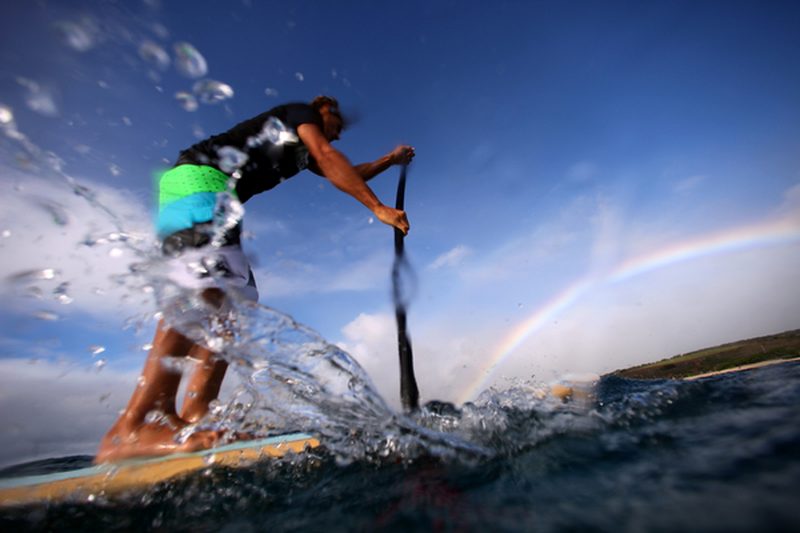
image used with permission by Flux Photography
Most paddlers know they need to be concerned with paddle technique to improve their efficiency and reduce injury. What is often lost in the discussion of paddle technique is the subtle art of board position.
Paddling, like other sports such as martial arts, golf, and surfing is a sport where nuanced and subtle moves can result in huge changes in performance. One of these micromoves is your position (e.g. where you stand, lie, or kneel) on a paddleboard. A few centimeters too far forward or too far back could mean all the difference in your paddle race.
Guidelines for determining your position on your prone paddleboard or SUP
One, albeit counterintuitive, place to start when getting your position dialed in on your board is the location of the tail of your board relative to the surface of the water. In an ideal world, you would like to keep the waterline of your board as long as possible.
As a very general guideline, this means that ventral margin of the tail of your board should just skim the top of the water at all times. This is a general guideline, rather than a hard and fast rule, because the position of the tail in the water will ultimately be determined by factors such as the tail rocker in your board (if any), water conditions, and what is going on with the nose of your board. Keeping a long water line is a good starting point. Under no circumstances, however, should your tail be buried in the water or significantly submerged, because submerging your tail is the paddling equivalent of driving with your brakes on.
The position of the tail in the water moves in lock step with the position of the nose of your board. As you move forward, the nose drops and the tail raises out of the water. As you move back the tail sinks and the nose rises.
With regard to the position of the nose of your board, you do not want the nose of your board either buried in the water (resulting in increased drag) or sticking up out of the water too far (as mentioned previously this is the paddling equivalent of driving with your breaks on).
When in doubt – nose (slightly) down.
We acknowledge the recommendations so far may be about as helpful as an ashtray on a motorbike because it gets you no closer in knowing exactly where to stand or lay/kneel on your board. Unfortunately, other than saying do not either sink the tail or the nose of your board, we cannot be more specific because depending on the shape of the nose of your board and/or nose rocker (if present) the ideal position of the nose of your board in the water will be different. Each board is different. Moreover, the sweet spot on a particular board will vary between paddlers of different weights and body conformations.
That said, here is one tidbit of information that you can put to use when determining your ideal position on your board. When in doubt it is better to have the nose of your board slightly lower (rather than higher) in the water (e.g. stand/lay/kneel more toward the front of the board) than have your nose sticking out of the water. In almost all cases having the nose out of the water will result in you pushing more water which will slow you down. Stated another way, when in doubt stand or lie slightly more forward than back.
This “opt for nose down” recommendation will also help you in a strong cross wind because you will have better control when the tail is slightly out of the water.
The one time this “nose down” recommendation can get you into trouble is if you are paddling a downwind or in heavy bump. Although a slightly nose forward position on your board can help you get into a wave, you run the risk of of perling if you are to far forward. If you are in downwind or bump you are going to have to be more fluid with your position on the board.
If you cannot find a good position
We started this post by discussing the importance of the water line (e.g. position of the tail) of the board. This is counterintuitive but important because it is often the position of the tail that will tell you if you and your board are not properly matched.
Although many board manufacturers make statements such as “this board is good for paddlers of all weights in all conditions” that is impossible. It is, however, possible that you and your board are not a good match.
If you find that despite your best efforts when your nose is in a proper position your tail is buried or it is completely out of the water this may be an indication that your board is not suited for your body conformation. For example, if your nose is in a proper position but your tail is excessively submerged, it is possible that the board does not have enough overall volume to support you or there is not enough volume in the tail of the board.
The bottom line is that the board needs to match the paddler. You will go faster on a better matched board than that ultralightweight/ultranarrow/supersonic whatever board your favorite 135lb professional paddler won their last race on.
Knee wells and handles are just starting points
In a previous article, we opined that the location of the handle in a SUP board is just a starting point for where you should stand . The position of the handle is, in many cases, the best place for you to carry the board. It is often unrelated to where you should be standing on your board.
The same goes for knee wells on prone paddleboards. Unless you are paddling a custom board it is certainly possible that your knees might be positioned a few centimeters back from the front edge of your knee wells.
Conclusion
Your position on your board is critical if you want to maximize your paddling efficiency. Do not underestimate how seemingly small adjustments in your board position will change the response of your board. A few centimeters can have a big difference particularly if you are a heavy paddler and/or your board has significant amounts of rocker. You are going to find that each board has it’s own sweet spot and that sweet spot will change slightly with water conditions, your technique, your weight relative to the volume and shape of the board, etc. Some boards are more forgiving for minor changes in your position on the board while position is more critical with other boards.
You need to experiment with your board to find the sweet spot. Sometimes it helps if you have a friend watching or get a video of yourself paddling. A GPS can be a huge help when you are determining the sweet spot of your board.
Next steps
As you can see, it is difficult to describe ideal board position in general terms. This topic, however, is critically important and it is one of the topics we are going to be addressing in our upcoming prone paddlboarding video. In the video we will show specific examples with different boards and discuss the differences between paddling position on stock and unlimited boards. Please be sure to sign up for our newsletter to get alerts when the video is ready and to get a discount when the time comes.