 09 May 2014
 Posted by mattwright
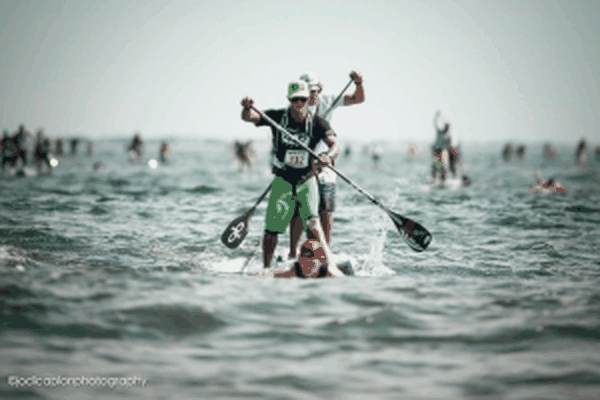
Photo Credit: Jodi Caplan Photography
I am training for the Cape Cod Bay challenge which is a 32 mile SUP race. I am using your long distance training program to help me get there. Our plan is to do a 3.5 mph pace which equates to about a 9 hour day. In your program the longest paddle before the race is 4.5 hours. My question is shouldn’t we be trying to do a longer paddle than that before the race? I have friends who do triathlon and bike and they do much longer workouts that seem to be almost as long as their races?
Cathy, Rhode Island
This is a really common question and the answer, to some degree, depends on what your goals are.
If you were a professional paddler and you told me that your goal was to win the race, I would probably have you doing some paddles longer than 4.5 hours because 1) you are a professional and you can recover from those types of efforts 2) you are a professional so you would be willing to organize your life around rest and training and 3) you need to get comfortable with very long efforts.
However, because you are not a professional, I would be very careful with paddling longer than 4.5-5 hours in any of your training paddles. These types of efforts are too taxing on the system of many amateur athletes. When you throw in work, life, family, and everything else most amateurs need to deal with it becomes very difficult to recover from 5+ hour paddles and stay on top of your training. What I am saying is that paddling for 5+ hours might do you more harm than good and get you in a training hole prone to overtraining syndrome and overuse injury.
Be careful when extrapolating paddling efforts to efforts in other sports. Cycling is a nonimpact sport that uses your big leg muscles. It is relatively easy to recovery from a long bike ride. Paddling is also non impact but you are using your core and arms which are not as resilient as your legs. Therefore if you paddle and cycle for equal times your paddling effort will be more difficult . This is why you hear about cyclists doing 5 hour rides routinely and even doing century rides before their century races. You will be paddling 9 hours. For you, that may actually equate to a double century effort!
Triathlon and marathon efforts are more like paddling because the running and swimming take a similar toll on your body as paddling. This is why you almost never hear of athletes doing a full Ironman or full marathon before their race. It is just too hard to recover from those types of efforts. If your friends are doing full Ironmans before their races, they will not likely have a long career with triathlon. Burnout and injury are going to get the best of them sooner or later.
The bottom line on all of this is that you could go up to 5 hours in your long paddle but more than that you might just be digging a hole. A better approach is to be consistent with your training and load up a weekend with 4 hours on Saturday and 2 hours on Sunday (e.g. take advantage of those optional paddles in the program). A 6 hour weekend sounds easy on paper but for the newer paddler that is a solid effort not to be taken lightly.
Your next question is probably going to be “if I only paddle 5 hours as my longest paddle before my race, how am I going to be able to paddle 9 hours on race day?” The answer to that question is that you are going to have to dig. Once you are in the realm of ultra endurance efforts your brain is as important as your physical training. You will either crack or you won’t. The other factor that will make or break you is your nutrition and hydration. We give you race day nutrition and hydration guidelines in the Riding Bumps book. All I can tell you is that having coached literally hundreds of Ironman athletes over the years, the training plan is solid and if you are going to be able to finish you can do it with a 5 hour paddle as your longest paddle.
Before I let you go….there is one last thing to mention. I do not know you other than the question you asked. Assuming you stick with your training and you have good paddle technique and the ocean and weather is in your favor my guess is that you might be able to maintain a pace slightly higher than 3.5 mph which will get you home faster than your planned 9 hours. You might surprise yourself if you stick with the plan and keep your training consistent.
Roch