 19 Apr 2013
 Posted by mattwright
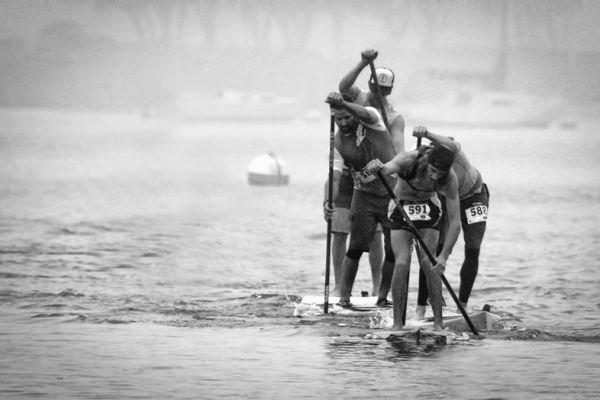
Drafting is a skill that you need to master to become a better paddler. Even if you do not plan on racing, all paddlers need to understand what goes on behind another paddler to avoid collisions when in proximity to other paddlers. The wake of a paddleboard can be a place to gain speed, take a rest, or become a veritable deathtrap if you are next to a powerful paddler and do not know what you are doing.
SUP and Prone Paddle Drafting basics
As a general rule, drafting is most effective in flat or semi-rough conditions where the lead paddler paves a path through the water. In very rough conditions (and always with a downwind) it is best to find your own path through the water.
When drafting in a pack the lead paddler is doing most of the work . The second person in line saves about 15-25% energy. The third person in line doesn’t have to work as hard as the second person in line, perhaps saving 20-40% more energy than the first paddler, and anyone else behind the third person saves around 20-40% of their energy. The only caveat we have (although we do not have data to prove it) to these numbers is that we feel that board size & type can affect the these numbers significantly. In our experience, unlimited boards may not see as such high percentages of energy saved as a stock SUP as suggested by these numbers.
The two main positions used draft off of another SUP or prone paddle board are
- directly behind the lead paddler in the “back wash”
- Along side of the lead paddler in a “side wash” position. Some refer to this technique as “riding the bump” of the lead paddler.
Which location is better? That is tough to say. You get more of a draft directly behind the lead paddler but it takes more effort and skill to come around the lead paddler to pass them. It takes more skill to ride the bump of the lead paddler but it is easier to pass and apply other race tactics from the side. Overall, it really depends on the situation so you need to know how to draft from both positions.
The two main skills you need to learn with regard to drafting are:
- Learning where to be relative to the other rider. Location is extremely important whether you are drafting from the side or directly behind. If you are too far back or to the side you won’t get the full effect of the draft.
- Learning how to get in and out of a wake. Traversing a wake can be a deathtrap and if done improperly you may tip your prone paddle board or fall off of your SUP.
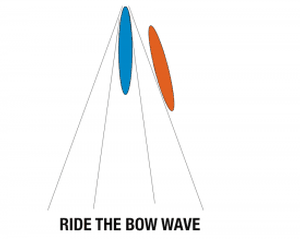
As we discuss the technique of drafting, we will refer to the following diagram.
As we stated previously, the lead paddler is doing most of the work. This is because they are pushing the water as they move forward. As the water is pushed to the side in front of them a wake is created behind them. The large wave on the side of the lead rider is termed the “bow wave.” There is also a secondary wake that is formed along side the white water behind the lead paddler. The space between the bow wave and the backwash is the inside wake.
Whether you decide to draft from behind or ride the bump along the lead paddler, you are going to have to learn to navigate the bow wave. The first thing you need to keep in mind when paddling behind another rider or next to another rider is that traversing the bow wave can be difficult if not dangerous.
As soon as your boards begins to climb on the bow wave, you will start to lose control. The area on top of the bow wave and immediately adjacent to the bow wave (and to some degree the secondary wave along the edges of the backwash) should be considered to be “no man’s land.”
If the rider in front of you is very strong or has a “bumpy” stroke the effects of the bow wave on your board can be dramatic. You may feel your board swaying from side to side or even tip over. If the tail of your board makes contact with the bow wave you may feel your board being sucked into the bow wave and rolling under you.
In all cases, attempting to ride directly on the the bow wave should be avoided and if you need to traverse the bow wave in order to position yourself behind another rider – do it fast.
If you are able to successfully navigate the bow wave or get in drafting position by padding in from directly behind the paddler in front of you, position yourself as close to the lead paddler as possible for the best draft. That said, even though you will get the best draft if you are positioned a few inches behind the lead paddler, the effect of the draft can be substantial so you will need to paddle carefully so you do not get sucked in to the lead rider. Bumping the riding in front of you is never OK. The optimal distance behind the lead rider will depend on your skill, the speed of the race, and the water conditions.
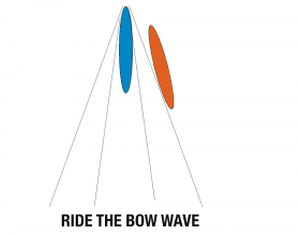
You will find that drafting in this position can save you energy but it will take skill to stay in the backwash. If the the lead rider is a powerful rider it can be a rough ride. If the lead rider is zig zagging you need to be especially vigilant to stay directly behind the lead rider or you will find yourself in no mans land on the side of the backwash.
Another option for drafting is to ride the bump along the side of the bow wave as depicted below
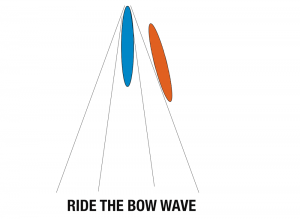
Riding the bump along the bow wave is difficult. You will be constantly fighting to maintain your position in the wake as the bow wave will create a vortex and suck you in toward the lead rider. To maintain your position on the bow wave, lean on the outside rail of your board and direct the nose of your board slightly toward the lead paddler. The bow wave will keep you moving forward in a straight line with the lead paddler.
When riding the bump of the bow wave, the optimal position is to paddle just caudal to the lead rider. You want to be paddling almost neck and neck.
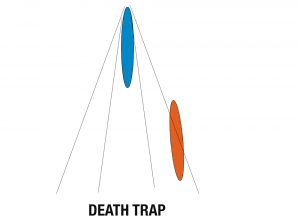
Be cautious when riding the bow wave if the lead rider is much stronger than you. If they get far ahead of you, the tail of your board is likely to make contact with the bow wave which will suck you into their wake, roll your board, and the nose of your board will be steered to the outside. Just so you are clear on this topic – the following image is included to remind you
- the bow wave is no man’s land and
- if you get sucked over the bow wave it can be dangerous for you and the riders around you.
Basic SUP and Prone Paddle Drafting Etiquette
- When drafting in a race with mixed board classes, drafting off of a larger board is considered unsportsmanlike conduct
- If you are drafting you should contribute to the success of the group. Do not sit in for an entire race and then sprint the lead rider at the end if you have not contributed to the effort. That is just cheesy. You will get much more respect if you take second than “pip” the lead rider at the line if you have been “sitting in” all race.
- If you are in a group of paddlers that are above your level and you cannot contribute, do not be afraid to tell them you are cracked. It is OK to say “hey guys – I cannot help. Can I sit here and take third or fourth or whatever.” In most cases they will allow you to sit in the lead group but do not, under any circumstances, try to sprint for the line at the finish.
- This whole death trap stuff is not to be taken lightly. We have seen paddlers fall off and/or hit other paddlers with their paddles as they traverse the bow wave. Remember, you are responsible for your safety and the safety of those around you when drafting. If you are not an experienced drafter – do not try to draft for the first time during a race.
- Do not ever bump the rider in front of you.
Next time in this series: Part 2: Drafting drills to help you become a better (safer) racer. Part 3: Defensive drafting: techniques to get someone off of your tail. Dont forget to sign up for our newsletter and get website updates delivered directly to your email.
References and thanks: