
 26 Apr 2013
 Posted by mattwright
I am finding some major differences from swimming technique versus prone paddling technique. I was wondering if, while knee paddling, do the arms recover by swinging to the side like they do in butterfly recovery or should they stay close to the board, bent, and almost pouncing forward (like Jamie Mitchell)? I have found the former to be easier on the traps and create less of a splash from the tail, but the latter feels more balanced…and is used by Jamie Mitchell… Thanks so much for your time and coaching. I love your new book, it answers so many of my questions that I feel more comfortable with my solo training.
Aaron, Anonymous location
Answer: Hey thanks for your question. Interesting story…
A while back I was paddling in Hawaii and Jamie Mitchell just happened to be heading off for a paddle at the same time and place. At the time I was having some shoulder issues. In an effort to ease the strain on my shoulder, I was using what you describe as a butterfly recovery. Given my swimming background assumed that bringing my arms out to the side would change the angle of my forearm relative to my shoulder and thereby ease my shoulder pain. I was thinking that paddling using a “cheetah” technique was similar to swimming doing a finger pull drill. Moreover, I assumed that the recovery technique did not significantly impact my paddling speed. The problem with all of this is that paddling is not swimming on a board.
According to Jamie Mitchell , a“cheetah” style recovery will allow you to have a faster turnover while you paddle which will allow you to paddle faster. As far as paddling speed goes, the cheetah recovery is superior.
The “cheetah” style recovery should also not negatively impact your shoulders. Unlike swimming, your arms and elbows are far out of the water and at a different angle relative to your torso while you are paddling. Keeping your arms bent during the recovery is no at all like doing a finger pull drill. As far as shoulder damage – there is no evidence that I am aware of to suggest that the “cheetah” recovery is any better or worse for your shoudler than the “butterfly” recovery.
The cheetah technique will also allow you to end your stroke sooner. Remember, all of your power comes from the first segment of your stroke. Any pulling or splashing you do once your arms go past your hips only serves to pull the nose of the board down and slows you down. A proper stroke will have you pulling your arms out of the water just past your hips. The “cheetah” technique will help you keep your forearms down and your elbows up to end your stroke at the proper time.
The bottom line on all of this is that the “cheetah” recovery will allow you to have a faster turnover, place no additional stress on your shoulder, and even help you end your stroke earlier. Below is an image of George Plsek and his pouncing cheetah style on the cover of our 16-week prone paddle training programs.
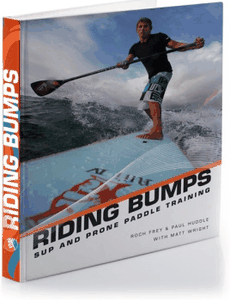
We are working on a prone paddle technique video that will be available free on the website. Don’t forget to sign up for our newsletter . We will let you know when it is ready.
Roch