 20 May 2014
 Posted by mattwright
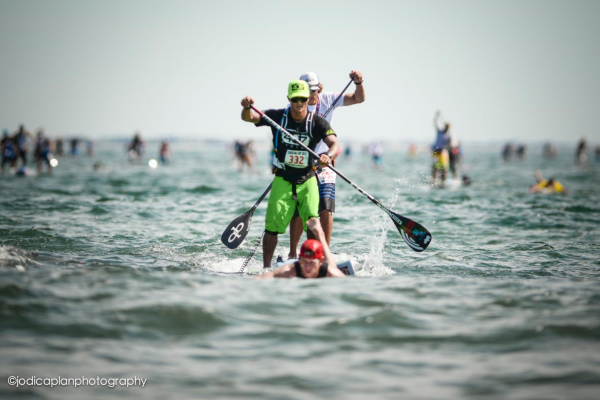
Photo Credit: Jodi Caplan Photography
The discussion as to whether drafting should be allowed in SUP is a discussion that was essentially put to rest this year. With the importance of the Carolina Cup increasing year after year (1), if you want to hang with the big boys and be in the best races, you are going to have to learn how to paddle in a drafting train. At races like the Carolina Cup effective drafting will make or break your race.
In a previous article we discussed the very basics of drafting for the SUP and prone paddler. Any paddler looking to do well at an SUP race that allows drafting is expected to know those basics. Practice them with your friends. Paddling in a drafting train is a skill. You need to learn good drafting etiquette before showing up for a race.
Inside the drafting train
To the outside observer it might look like a drafting train is just a bunch of guys taking turns paddling. Anyone who has been on the rivet (2) in a race trying to sort out how to win the race while you are helping pull other people to the line knows better. The reality is that the drafting train is as much a psychological war of attrition as it is a physical challenge. When you throw drafting in the mix a pure test of fitness is turned into a game of strategy where the smartest (and not always the strongest) paddler wins. In many cases a drafting train is a game of cat and mouse.
In a drafting train, paddlers work together against all of the other competitors in the race. For the paddlers in the train, their goal is to form a temporary alliance and make sure that the drafting train is successful. At the same time, however, they are positioning themselves within the train to determine how they are going to win the race and limit the success of the other racers in the drafting train. In many ways, racing in a drafting train is a lot like The Hunger Games . You have allies at the start of the game but at some point you are going to have to turn on your allies if you want to win.
There are loads of race tactics that are used while drafting. Discussing all of them would require a half day clinic. In this article we will be highlighting a few of the common scenarios with the main goal of identifying “rookie” mistakes that paddlers make when racing in a drafting train. The other goal of this article, even if you don’t race, is to help you see that there is A LOT gong on in a drafting train and appreciate what the racers are going through. Finally, we hope that you realize that you need to practice drafting and drafting tactics to be a successful racer.
Tactics and psychology immediately after a drafting train forms
At some point in a race a drafting train may form where a group of paddlers “goes off the front” of the race. To establish a train all of the paddlers must contribute to the success of the drafting train. As a general rule, establishing a train at the front of a race takes a sprint level effort to get away from the main pack. The psychological rookie mistakes that occur at this point in the life of a drafting train are
- Believing that the pace will continue indefinitely: Remember, it takes a monumental sprint level effort to establish a drafting train at the front of a race. Nobody can sustain that effort indefinitely. You need to do everything you can to stay with the group while the train forms but tell yourself that the pace will slow down. It always does. In fact, what happens is that when the paddlers at the front of the main pack see that they are gapped, they give up, slow down, and settle into a rhythm in hopes that the drafting train splinters later in the race and the pack comes together.
- Believing that you are the weakest link: when a drafting train forms, everyone is hurting. Do not let your head get the best of you in the first minute or two as the break is forming and tell yourself that you are having a bad day and you are not strong enough to be with the group. If you can stay with the train, stay with it. Recover when the pace slows after a minute or two.
- Assess the other racers in the drafting train and position yourself accordingly: If you are a weaker paddler in a train your instinct is going to be to position yourself at the back of the train. If you are much weaker than the rest of the pack this might be a good idea because if you fall off the pace and get dropped you won’t disrupt the pack. If, however, you are the “weakest among equals” you should consider positioning yourself at the front of the train. This way, if you fall off the pace slightly you can jump on the end of the train and stay with the train once the pace slows down.
Whatever is going on in your head while the train is forming you need to remember that in the beginning you are working for the train. The train is your temporary team. Put your own race ambitions aside. You are going to have a much better chance at winning a race if the train is successful and you are only contending with a few other paddlers than if the train fails and the race comes down to a massive group sprint at the end.
Tactics and psychology in the middle of a race lead by a drafting train
Once the train is established your job is to “contribute but conserve.” Every drafting train has a life, a tone, and a very specific group dynamic. You need to be in tune with the group. You need to find your role, learn your place, and respect the leader(s). These group dynamics are unwritten rules based on subtle clues, glances, and other nonverbal hints. Your contribution needs to be on par with the rest of the paddlers. No more. No less.
The biggest rookie mistake you can make is to try to be a hero and “impress” the leaders to show them you belong on the drafting train by putting out a big effort when it is your time to pull. As they say, “you only have a few matches to burn” so use them wisely. In fact, putting out an effort that is out of sync with the rest of the group is a sign of aggression and will only upset the other paddlers. When it is your turn to lead the train, keep your effort consistent, keeps your stroke rate steady, and do not surge when it is your time to lead.
At the risk of belaboring this point, getting on the front and taking a “monster pull” has no value to you or the train. Remember, in the middle of a race, drafting in a drafting train is generally a war of attrition. In many cases the winner is the paddler who conserves their energy the most. When you are on the front, the paddlers behind you are feeling the effect of the draft and they are putting out an effort that is 10-20% less than you are. Unless you can put out an effort that is greater than 20% better than the rest of the paddlers in the train AND MAINTAIN THAT EFFORT FOR THE REST OF THE RACE you have no chance on doing anything worthwhile by getting on the front and taking a monster pull.
Monster pulls by rookies are, however, exceedingly common. This is because adrenaline and bravado get the best of even the most experienced racers at one point or another. The reason that paddlers take monster pulls (and then blow up) is that when you are sitting at the back of the train you are having an easier time than everyone else because of the draft. You feel like a million bucks and when it is your turn rather than maintaining the pace of the train you go a little harder than the last guy pulling. After a few minutes you realize you cannot hold the pace and the only reason you felt like a million bucks at the back of the pack is because of the effects of the draft. Inevitably you slow down. At best the rest of the pack is angry with you for disrupting the flow of the train. At worst, you blow yourself up and you get dropped.
The bottom line for this segment of the story is that you should maintain the pace of the train rather than take monster pulls when it is your turn to pull. You won’t impress anyone with your strength but you may blow yourself up and upset a few of the more experienced paddlers in the group. Conserve your energy and allow the train to develop. If all goes well, a few paddlers will fall off the pace over time. Later in the race, when it comes time to make a move, you have conserved your energy and you have fewer paddlers to deal with.
Every rule has an exception
Although maintaining the pace of the drafting train is a generally accepted practice, George Plsek, a long time expert prone paddler who was caught in the middle of the draft train on his unlimited board at the Carolina Cup race, reminds us that every rule has an exception. “If you looked closely at the drafting train at the Carolina Cup what you would also see is that the most experienced paddlers surge for about 30 seconds when it was their time to pull. What they were doing was different than what the inexperienced paddlers were doing. It seems that the “heads of state” in that race knew their abilities and they were putting out little efforts from time to time to see who could keep up. They were testing the pack but not putting out an effort that would put their race in jeopardy. After 30 seconds they settled into their own comfortable pace. The top paddlers knew exactly what they were doing up there. They were racing strategically. There were no random efforts or acts of bravado.”
Tactics and psychology later in the race lead by a drafting train
All alliances in a drafting train come to an end. The decision about when to end the alliance will be made by you, or for you, depending on how you want to race your race. At some point someone will make a move that will either “shuffle the deck” where the train will get disrupted but come together in a different order (plus or minus a few paddlers who did not make it through the shuffle) or the train will come apart with one or two paddlers taking the lead. The ultimate outcome of the drafting train will depend on who is in the race.
Considering all of the ways to break up a train and win a race is outside the scope of this article but if things start happening toward the end of the race you need to realize that the alliance is over and it is time to make a move.
As an example of what might happen toward the end of a race consider a drafting train composed of sprinters and “diesel engine” style paddlers who are strong paddlers who lack top end speeds and/or quick bursts of speed.
The sprinters want more than anything else for the train to succeed to the end where they can launch a final attack and win the race in a sprint. The “diesel engines” of the group need to be more cagey and find a way to disrupt the train so they can break free whiteout dragging a sprinter to the line. These paddlers might put in repeated, sustained, submaximal surges at the front of the train in an effort to crack the sprinters and/or break free from the front of the train.
Ultimately the tactics at the end of the race may be dictated by ocean conditions. For example, in this year’s Carolina Cup race, the last 3-4 miles of the race was in rough ocean with very little down wind. This is where Danny Ching made a move and nobody could match his move paddling in the rough conditions at the end of the race. Maybe that was his game plan all along. Maybe Danny was playing the cat and mouse game all along and conserving his strength until he could lay the hammer down at the end of the race. All we know is that Danny was not in the front of the train all day taking monster pulls. If you want to win races, study the race tactics of Danny Ching. He knows what he is doing.
Footnotes:
- Drafting off the same size craft and same sex is legal at the Carolina Cup
- On the rivet is a term used in bike racing to describe an effort to the point of almost giving up. In the old days, bike seats had rivets. In an effort not to get dropped racers would slide forward on the saddle wher ethe shell of an old letaher saddle would be attached to the saddle frame with a rivet.