 31 May 2014
 Posted by mattwright
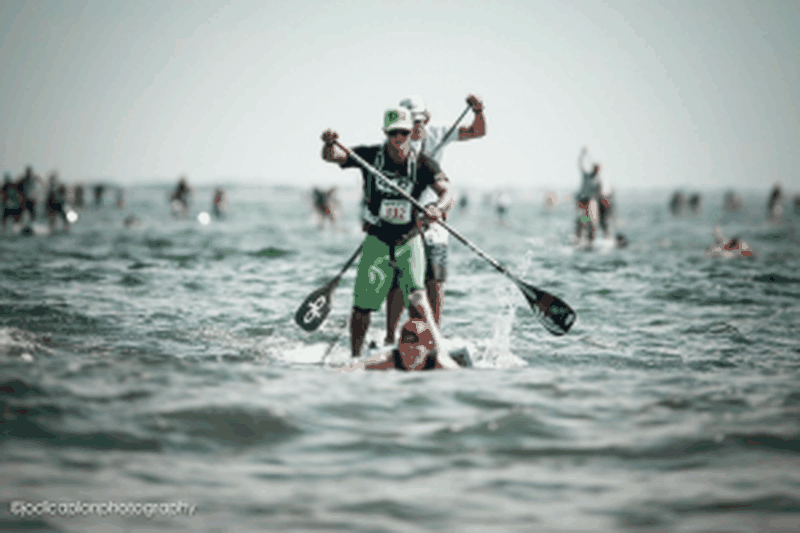
At one point or another, just about every SUP racer will decide that it is time to get serious and look to maximize their performance. The problem is that maximizing performance without the assistance of outside feedback, such as monitoring devices or a coach is notoriously difficult.
We are proponents of racing and training with heart rate. In a sport like SUP, however, if you want to maximize your performance you may need to go beyond training by heart rate.
Because paddle technique is such an important consideration in SUP racing, training solely by heart rate without consideration of your technique may result in paddling with faulty movement patterns that will negatively impact your performance and could even lead to injury.
Many paddlers step up from heart rate monitoring and graduate to combined heart rate and GPS devices that allow them to monitor speed and heart rate simultaneously. Although GPS data, such as speed, can yield interesting information, paddlers are cautioned that speed is a metric that is influenced by factors outside of your control such as wind and current. Therefore, training by speed without additional information can lead to erroneous conclusions regarding your performance.
For example, lets say you paddle a stretch of water every day. One week you are paddling at a heart rate of 140 and a speed of 4MPH. The next week, you are paddling with a heart rate of 140 but your speed is 4.5 mph. With only this information, you do not know if the speed difference is due to a decrease in a headwind, are you paddling faster, are you putting more force on the paddle, is a current moving you?
As you can see, although there is a correlation between speed and heart rate that correlation is rarely 100% and may even be inverted. Sometimes your heart rate will go down and you will go faster (e.g. a tailwind) and sometimes your heart rate will go up and your speed will go down (e.g. poor technique or too high of a stroke rate).
A conclusion can be made, therefore, that speed and heart rate are only two sides of the paddle training triangle. In other sports a third metric, power, is used to directly measure your performance. Power allows you to relate heart rate and speed because power data is not related to currents, headwind, or any outside factor. Your power output is your power output and that is all there is to it.
Although we have heard rumors about power monitors for some time now (and we expect to be talking a lot about power in the future) currently, power data is not available to SUP racers. Stroke rate and glide, however, are two additional metrics that are available that can help you assess your performance and estimate the relationship between heart rate and speed.
As an introduction to stroke rate and the effect on power, the following is an excerpt from Dave Kalama’s website where he relates stroke rate to power and efficiency.
Rushing through the initial power phase of the stroke without taking the time to really drive the paddle down into the water causes you to miss out on potential power that would cost you the same amount of energy. Avoid being too hasty in getting the paddle into the water without a complete stretch of your reach; it only costs you a little patience and time to completely extend your arm forward. Also, rushing through the recovery phase will break the flow of a smooth rhythm, which is where real efficiency resides. If you rush into getting your hips all the way back under you to the neutral position, then you miss out on all the potential momentum you can generate through the hips.
The reason so many of the good paddlers look good, is because they take the time to maximize each phase of their stroke which projects an air of smoothness and rhythm. Since they move through each phase completely and without rushing, it looks smooth and ultimately translates to efficiency. This is the key to speed.
The conclusion can be drawn from this excerpt that the “key to speed” lies, in part to stroke rate. Given the importance, monitoring stroke rate during your racing and training may be important.
Enter the NK Speedcoach SUP
Although we have heard of paddlers who assess their stroke rate by counting strokes over time, in our experience (maybe we are bad counters) counting strokes is a daunting task prone to error. The main problem is that in paddle sports such as SUP, the overall stroke rate is relatively low. Therefore, it can be very difficult to detect a change in your stroke rate. Given that a change of 3-4 strokes per minute can have a huge impact your performance, stroke monitoring must be accurate. If you are serious about maximizing your performance investing in a tool to monitor your stroke rate may be a good investment.
Recently, we were provided with Speedcoach SUP units from NK(1) . The following is our initial experience with the NK Speedcoach. In a follow up article we will discuss how to use the Speedcoach to help assess your paddle performance and dial in your training.
As stated previously, in addition to heart rate and speed, you will need additional metrics to help estimate your power output. The NK Speedcoach provides you with the following data:
- Heart rate:
- Stroke rate:
- Glide per stroke: this is the “killer metric” if you will. As you will see in Part 2 of this series, without this number it can be difficult to determine your ideal stroke rate for a given water condition and set of equipment.
- Speed:
NK Speedcoach first look
The NK Speedcoach is a simple device. After a quick charge, setup is straightforward and easy. The unit is attached to your board with a mount and 3M dual lock tape (e.g. velcro on steroids). In our experience the “velcro” type adaptor may fall off going through the surf or a wipeout. To avoid losing our unit (which is not buoyant) we attached an EZ plug t o the board and threaded the attached leash through the plug. Problem solved.
When mounting your NK unit, be sure to mount it in a position where you will not whack the unit with your paddle as you change sizes. We know of one paddler who knocked her unit off her board. The unit was never seen again.
One issue you may encounter is that the NK unit is held at a fixed angle relative to the board. This means that you are somewhat limited where you can position the device and still be able to view the information (e.g. if you put it directly at your feet you wont be able to see the screen).
The good news is that NK will soon be releasing a GOPro adaptor which will obviate any issues with viewing angle, you will not need an additional adaptor if you already have a go-pro mount, and you likely wont need to secure your unit with an EZ plug+string.
One key feature of the NK Speedcoach is the fact that it takes readings from GPS satellites 5 times per second rather than every second, which is the standard for most GPS sports watches. When compared to our Garmin 910XT the speed reading on the Speedcoach did change slightly faster than the Garmin. This may be valuable when you are getting your stroke rate dialed in as second by second changes in speed and glide may be important.
The one area paddlers have expressed concern over is price. In our opinion the price of this unit is not far out of line with other GPS units including the popular Garmin 910XT. When deciding on purchasing a Garmin vs. a monitoring device that tracks stroke rate you will need to weigh the pros and cons of stroke rate vs. mapping and download functions that the a Garmin has that the Speedcoach does not. One thing groups of paddlers should consider is to purchase a Speedcoach as a group and share the unit. Tracking stroke rate and speed is not something that is necessary with every paddle workout. A group of paddlers could easily share this unit for a few bucks each. The benefit will certainly outweigh the cost.
Next up Part 2: using stroke rate and glide metrics to help you find your ideal stroke rate and a case study looking at one professional paddler who decreased his stroke rate, increased his speed, and was named to the ISA worlds team along the way.
(1): FULL DISCLOSURE: These units were provided for no charge. NK did not place any requirements or limitations on their use. NK did not request a review of anything we were going to post before posting.