 16 Jun 2014
 Posted by mattwright
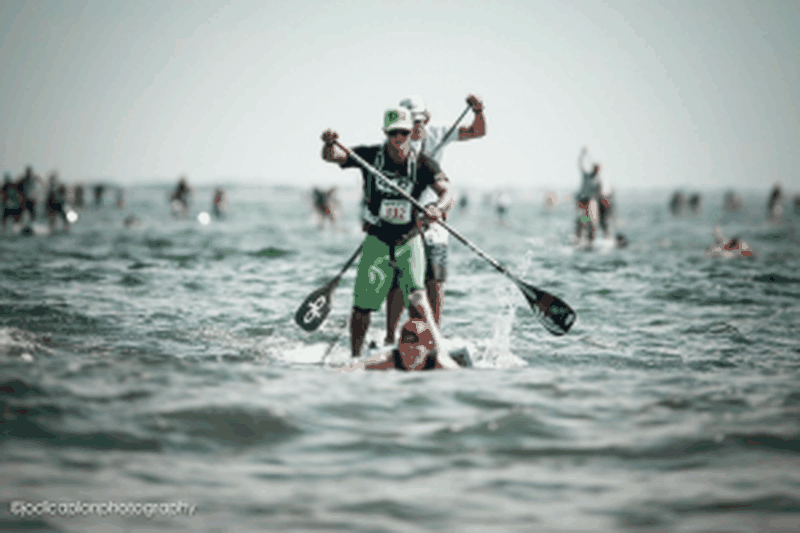
Although it might seem intuitive that paddling faster will make you go faster – this is not always the case. As a general rule, as you paddle faster, your power per stroke decreases. At some point your stroke rate will be limiting, as your power per stroke will decrease to a point where the added stroke rate is detrimental to your speed.
According to Jim Terrell of Quickblade Paddles:
Generally speaking, you will see most of the top paddlers paddling distance races in the high 40 to low 50’s SPM. For starts and sprints, you will see most of the more efficient paddlers, paddling in the high 50’s to low 60’s. If you are paddling much faster than these rates, you more than likely have an opportunity to improve your speed by paddling more efficiently. If you are paddling much slower than these rates, you more than likely have an opportunity to improve your speed by improving you fitness, strength and efficiency.
All of this makes intuitive sense. The question then is “what is your ideal stroke rate?” Answering that question, however, is not at all simple.
The main issue with giving a quick answer to “what is my ideal stroke rate” is that you may have many ideal stroke rates. Stated another way, your stroke rate will vary depending on your equipment, your paddle blade size, water conditions, your physiology, and what type of race you are racing.
To give you a few examples of how these factors will impact your stroke rate
- Paddle blade size: a smaller blade will require you to increase your stroke rate to maintain the same speed. Many paddlers use different size blades for different races.
- Board length: a longer board will generally require a slower stroke rate to maximize glide
- Water conditions: choppy conditions will generally warrant a higher stroke rate
- Your physiology: some paddlers have a naturally higher stroke rate and rely on their cardiovascular system while other paddlers use a big powerful stroke and rely on their musculature
- Your racing style: shorter races (especially sprints) may require a faster stroke rate.
As you can see there are a number of variables that will impact your stroke rate. For this reason, neither us nor anyone else can give you an answer that tells you what your ideal stroke rate is. To determine that you are going to need to do some testing.
Starting out using stroke rate monitoring and metrics
In a previous post we discussed the NK Speedcoach and the fact that it provides you with 4 data points: heart rate, speed, stroke rate, glide per stroke.
4 data points is A LOT of data to parse as you attempt to assess the interplay between these factors and their effects on your paddle performance. If you want to use stroke rate data to assess your performance, our recommendation is to keep 3 of the data points static (as best you can) and vary a single data point and see what happens to the other two. The following is one scenario to give you an idea of the kinds of “studies” you can do to assess the impact of your stroke rate on performance. “Studies” such as this will help you dial in on your ideal stroke rate BUT these tests are prone to error. When getting started with testing, our recommendation is to do your tests in flatwater conditions with no current or wind as these factors will complicate interpretation (or render your data essentially meaningless). Second, you will need to repeat your testing over time to improve your data set (e.g. if you are tired one day that may have an affect on your data).
Estimating your “ideal” stroke rate in flat-water conditions at your middle distance race pace: The following is a simple test you can use:
- Step 1: While paddling at your heart rate zone 2 at about 40 strokes per minute, increase your stroke by 2 strokes every 2 minutes and see what happens to your speed and glide per stroke. Your glide per stroke will likely go down. Your speed may go up or down. Your heart rate will go up over time because you are paddling faster. Stop this segment of the test when you reach your heart rate zone 4.
- Step 2: paddle easy at your heart rate zone 2 for 5 minutes. This is intended to be used as a rest and recovery
- Step 3: Paddle at your heart rate zone 3 at a comfortable stroke rate but this time lower your stroke rate 2 strokes every 2 minutes and watch what happens to your speed and your glide per stroke. Your speed will go up or down and your glide per stroke will increase slightly. Stop this segment of the test when you reach your heart rate zone 2.
As you analyze your data you will find a “power band” where your speed is maximized relative to your heart rate at your middle distance race pace.
This is just one example of a test you can use to determine your ideal paddle rate in a static environment. Similar tests can be performed to determine your ideal stroke rate and/or equipment. For example, what is the effect of using a paddle with a smaller or bigger blade face, what type of stroke rate can you handle over time in longer races? Shorter races? What is your ideal stroke rate on a 12-6 board vs. a 14-foot board? How much testing you do will depend on how much you want to get your stroke dialed in.
A real life example of how one paddler used stroke rate/glide/ speed to adjust their paddle cadence.
One of the Riding Bumps authors and Laird Standup team rider, Chuck Glynn , recently ran similar tests and found that decreasing his stroke rate resulted in increased speed, increased efficiency, and improved performance. In the past Chuck paddled at a stroke rate of 70+ strokes per minute. During testing, this stroke rate resulted in an average speed of approximately 6.5-6.7 mph. After working with the Speedcoach to monitor his glide, speed, and stroke rate, Chuck found his “power band” at a rate of approximately 60 strokes per minute. The decreased stroke rate resulted in a slightly higher average speed of approximately 6.8 mph. Although the speed increase is not dramatic (and might be due to statistical noise) the decreased stroke rate has allowed Chuck to dramatically increase his efficiency while paddle racing. This has allowed Chuck to race stronger over loger distances. According to Supracer.com , Chuck “is quickly becoming one of the most elite paddlers in California.” Part of the reason is paying attention to details such as stroke rate while racing and training.