 26 Sep 2016
 Posted by mattwright
If you look around the boards, blogs, magazines and even our website there is talk about shoulder health and injury from SUP and prone paddling. The fact of the matter is that unless you have exceptional shoulder, spine, and hip mobility, paddling can be deleterious to your musculoskeletal health.
Paddling puts great strain on your shoulders and spine and if your connective tissues are not up to snuff all of this can translate into low back, elbow, and hip issues in a hurry. If you are experiencing any sort of chronic pain in your back, elbows, shoulders etc., judging from the volume of emails we get about injured you are not alone.
For those of you in San Diego, you might notice that one of our editors, Matt Wright, has been notoriously absent from the paddle workouts in the last year or so. There were a number of reasons for this but one of the main reasons was that after shoulder surgery a few years ago he was suffering from chronic shoulder pain in his good shoulder (e.g. the shoulder he didn’t have surgery in) and chronic low back pain. Truth be told, it got so bad he was convinced that he was going to need lumbar spinal surgery.
One thing lead to another and a local physical therapist said that his thoracic spine essentially didn’t move, his hips and hip flexors were tight, and his shoulders were tight. Basically, he was like many older athletes after 20 years of endurance sports and working at a desk, he was completely jacked up.
If you know Matt, you know that his response to everything is “this is bullshit.” So he set out to prove this physical therapist wrong. He went full tilt on a mobility and strength program (more on that in a minute) and proved himself to be the chump. In 6 months of focused mobility work he fixed his low back pain, fixed his nagging shoulder pain, and even fixed a chronic hip issue. At 45 he is essentially 100% pain free*.
The reason we are telling you this story is that after the upcoming Pacific Paddle Games and Chattajack race on the east coast, it is break time for most racers as the off season is here. At this point we are probably a broken record to many but just like we recommend every year, it is time to turn the dial down on paddling and do something different. Change is critical.
What you do with your time is up to you. For most of us, that will mean cross training, running, mountain biking, etc. The problem is that those activities, to some degree are more of the same. Maybe this off season you should focus on your mobility and strength and maybe do it in a way that you haven’t done before. Whether you currently have nagging pains or not, focusing on mobility and strength in the off season will only serve to help you later in life. Paddling is hard on the body and eventually you are going to jack yourself up if you ignore your body.
Enter Gymnastic Strength Training
Getting back to our story, once our editor realized his physical therapist was right he wanted more. The problem was 1) he was never going to work on mobility at home alone (too boring and painful and frankly he didn’t know what to do) 2) he was never going to go to a yoga class (too much woo woo hooey for him) 3) and after lifting weights in the gym for like 30 years he was over that too.
Our editor, after listening to this podcast decided to give gymnasticbodies.com a try. Long story short, after a few months he is pain free. Zero shoulder pain. Zero low back pain. Problem solved. Additionally, he feels stronger than in the past and the heaviest weight he has lifted in the gym was 10 lbs and that was to assist in a flexibility exercise.
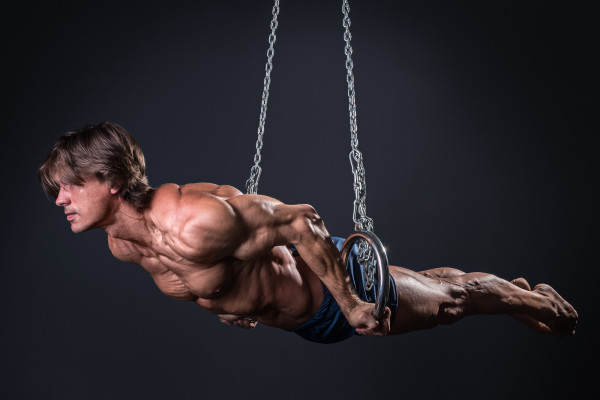
Although it is outside the scope of this (already too long) blog post to go to deep into the program, the Gymnasticbodies.com program is a mobility and body weight strength program designed to help you do some of the gymnastics type things like rings and handstands over time. To give you an idea of where they take you, check out their youtube channel.
Whether you are interested in doing rings or a handstand is besides the point. The early stages of the program is more of a general mobility and conditioning program using primarily your body weight. If you don’t think you can get a workout using just your body weight – whatever. Once this program gets going it will kick your butt. That said – be careful. Although doing a program like this in the off season is encouraged, we are worried, however, if you add this program on top of your normal paddle training during the season you might find yourself overtrained. It was not designed to be used on top of an already full endurance program.
On the quasi-negative side there are two (non)issues to be aware of:
- Some would say the program is expensive. We say – nonsense. You spent $300 on your paddle. You spent $700 for that flight to Molokai. You are going to spend way more with the surgeon and physical therapist if you ignore your body.
- Deciding which program is right for you can also be a little confusing. Start with the fundamentals. This is a general mobility program that will leave you with the perfect pre-paddle warmup routine. Many paddlers will stop here. If, however, you are like our editor you will move on to the Foundation course. This is where the body weight conditioning + mobility workouts start. Although it seems like the Foundation course is a stand alone, it is likely that if you are going to drink the Kool Aid and go that far you also need to be doing to the Front Splits, Middle Splits, and Thoracic Bridge series. Be warned, this is a commitment and the stretching workouts are brutal (if you are like most desk jockeys anyway)
If you are thinking that this sounds like an infomercial for gymnasticbodies.com – we agree. It does. We do not, however, have any relationship with them at all. More importantly whether or not you do this program is beside the point. This off season do something different to give yourself a break from paddle race training. We challenge you to work on your strength and mobility in movements other than paddling.
* Full disclosure: Matt needs a hip replacement. When he says he is 100% pain free he is excluding his hip pain which is an articular/cartilage issue. All of his nagging aches and pains outside the joint, however, are resolved.