 01 Jul 2014
 Posted by mattwright
Question:
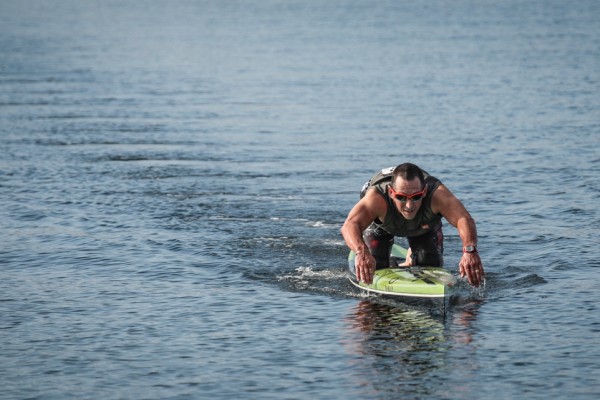
I’m a prone paddleboarder who rides an 18’10 unlimited board with outstanding glide. I was wondering about the relationship between stroke rate, speed, and glide. Specifically, how much time should I “pause”between strokes to maximize the glide potential of the board. For example, I find that in interval training my stroke rate might be near max, but my speed is less than that attained after I stop paddling and the glide sets in. I’m also interested to hear how other paddlers use stroke rates during races—ten strokes and glide, more, less, etc. Finally, I notice a huge difference between glide and speed on my UL as opposed to my 15’ board. How does all this change when going from a UL to stock?
Answer:
Great question. Really good. We have some background on the concept that you summarized in your question (e.g. paddling faster doesn’t always make you faster) here and here and here .
With regards to the specifics of prone paddling we decided to consult the paddleboarding royal family of Joe and Jack Bark because if they couldn’t answer your question nobody can. This is how they responded:
From Joe Bark
The unlimited boards are fast and carry the glide but it takes a powerful stroke to get the board up to speed to get that glide. There is a fine line of how fast of a turnover you need to achieve that speed to get the glide. If the turnover rate is too high it can slow the max glide speed down a bit because arms and hands are entering the water too soon when you should be gliding. A stroke that is too slow lets the board slow down between each stroke and the glide is not achieved. Each paddler has his own power band and a board that fits his or her weight to strength ratio will make paddling more enjoyable.
A stock board will be a higher turnover but less power needed for each stroke. All board should be tested in the water with a GPS for speed and in all water conditions. The only two things that should matter when testing a board is speed and stability. Every paddler will find his own stroke rate by using a GPS and trying different stroke rates to see which one maximizes the speed. I highly recommend everyone using a GPS when training when trying to determine their stroke rate.
There are two points we would like to highlight in Joe’s answer. First, we agree with Joe’s suggestion to use a GPS or outside monitoring device when determining your ideal stroke rate. You just cannot determine your speed or glide without metrics. We are currently testing the NK Speedcoach to see if the Speedcoach would be helpful in this regard.
Second, Joe mentioned that the board needs to match the paddler. We have seen many paddlers buy used boards that were not appropriate for their size and weight. This can be a disaster and, ultimately, these paddlers may spend more money on their board than if they purchased a new board with the help of an experienced friend or shaper.
Jack bark added:
The big difference between stock and unlimited board (UL) is the stroke rate! UL is a much more powerful stroke but requires fewer strokes to take advantage of the glide. Conversely, when paddling a stock board you will have a much faster turnover to make up for the lack of glide.
All of that said, we are working on board shapes to maximize the glide in stock boards. For example, new commander we’ve seen a way better glide now that people are riding the 20 lb. commander from Surftech. Where a custom is usually 16-18 lbs., the commander has a longer glide and it’s actually a advantage in the bumps and flat water.
So, just to summarize where we are so far, the Barks are catching with you are throwing and the stroke rate of a prone board is significantly higher than an unlimited board.
To give you some specifics on numbers to get you in the ball park (again everyone will have a stroke rate that works best for them and the stroke rate that maximizes speed on their particular board will be 1) board dependent 2) dependent on what you are doing (e.g. knee paddling, prone paddling, racing, cruising, etc.)
Regarding paddling an unlimited board, Roch Frey added:
As for stroke rate I am at 50 strokes per minute when going easy and 60 when going hard. That is not a huge difference but the stroke quality is also different. When I am going slower the stroke is longer and more powerful. In my experience, a stroke rate faster than 60 is the point of diminishing returns where I am losing glide and just churning up the water.
As far as ratio to maximize your speed between prone and knee paddling, I find that 1-2 minutes prone and 2-3 minutes knee paddling are the ratios that work best for me on an unimited board (e.g. 1 minute prone then 2 minutes on my knees). Although I can paddle faster on my knees, in my experience, going longer than 2-3 minutes on my knees results in fatigue in my back and legs and when I fatigue I lose the speed gained by knee paddling. I find it is best to power hard on my knees for shorter periods then get down on my stomach to rest up. Repeat.
On flat water it is best to take 80-100 strokes straight when you first get on your knees and then no less than 12 strokes with short pauses between until you need to lay back down prone…don’t glide too long when you do take breaks between strokes on your knees or your speed will drop and then it will take that much more power to get back up to speed. Use your GPS and adjust your glide time so that the board never slows more than .4 mph from the average when you are powering on your knees or you waste precious energy getting the board back up to top speed.
Price: $34.95 Prone Paddleboarding: Essential Techniques from breedfreakphoto on Vimeo .